

What You’ll Learn
This study demonstrates how quickly driver behavior can change when real-time feedback is introduced, and what level of improvement you could expect to see.
You’ll learn:
- How fast measurable improvements can occur once feedback is enabled
- What level of reduction in risky driving behaviors is achievable in weeks, not months
- How your current performance compares to a controlled before-and-after benchmark
Two Weeks. Measurable Change. Immediate Driver Behavior Improvement.
How quickly can driver behavior change when drivers know someone — and something — is paying attention?
To measure the real-world impact of driver assistance technology, a controlled study was conducted across 18 vehicles over two defined two-week periods:
- Phase 1 (Baseline): Vehicles operated without driver assistance
- Phase 2 (Intervention): Vehicles operated with Teletrac Navman’s driver feedback solution enabled
By isolating the introduction of driver-assistance technology, the study clearly measured how quickly behavior shifted when real-time feedback was provided.
The results were immediate and significant.
This study provides a clear benchmark for how quickly behavior can improve when feedback is consistent and visible.
Immediate Behavior Change. What Was Achieved in Just Two Weeks
Within just two weeks of activating driver feedback:
- Harsh acceleration events decreased by 70%
- Speeding events decreased by 30%
These aren’t minor behavioral tweaks. They represent meaningful reductions in high-risk driving patterns that directly influence:
- Collision exposure
- Fuel consumption
- Vehicle wear and tear
- Insurance pressure
Driver feedback didn’t just monitor behavior, it changed it.
What This Means for Your Fleet
Rapid improvement in these behaviors indicates that drivers can respond to feedback in real time. If you see that reductions aren’t occurring, it may suggest that feedback isn’t immediate, clear, or visible enough.
This study shows that behavior change can happen quickly, not over months, but weeks.

Reducing Reactive Driving is a Key Indicator of Driver Awareness
The improvements extended beyond acceleration and speeding.
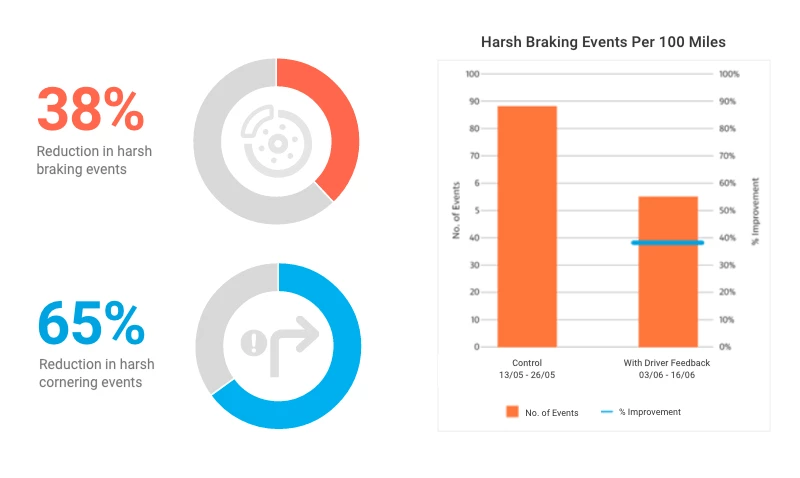
With driver assistance enabled:
- Harsh braking decreased by 38%
- Harsh cornering decreased by 65%
These behaviors are often associated with distraction, inattentiveness, or reactive driving. Reducing them improves:
- Road safety
- Vehicle longevity
- Claims frequency and severity exposure
- Brand reputation in the communities you operate in
When drivers receive immediate feedback, unsafe habits are corrected faster, without waiting for post-incident coaching.
What This Means for Your Fleet
Harsh braking and cornering are often tied to distraction or reactive driving.
Reducing these behaviors improves safety and lowers exposure to avoidable incidents.
If these behaviors persist for you, it may indicate a lack of continuous feedback or reinforcement.
The Business Case for Immediate Feedback
This study wasn’t conducted over years.
It didn’t require a full fleet overhaul.
It measured change over 14 days.
The takeaway is clear: when drivers receive real-time behavioral feedback, performance improves rapidly, reduces operational risk and cost exposure almost immediately.
Ready to Accelerate Safer Driving in Your Fleet?
See how quickly driver assistance technology can improve safety performance across your vehicles.
**Results are based on a limited pilot study conducted under specific operational conditions. Individual fleet results may vary depending on vehicle type, driver behavior, operating environment, implementation approach, and other factors. Past performance does not guarantee future results.