

What You’ll Learn
This study shows what measurable behavior change looks like when integrated cameras are deployed at scale, and what level of improvement fleets could expect.
You’ll learn:
- What level of reduction in speeding and aggressive driving is achievable across a large fleet
- How visibility and accountability influence driver behavior over time
- How your fleet’s performance compares to real-world benchmarks
173 Vehicles. 7 Months. Measurable Risk Reduction.
What happens when visibility meets accountability?
To evaluate the real-world impact of integrated cameras on fleet safety, a 7-month study was conducted across 173 vehicles between October 2024 and April 2025. The vehicles operated with the Teletrac Navman integrated camera solution as part of the TN360 fleet management platform.
The objective was simple: measure whether real-time visibility and coaching change behavior at scale.
The results were clear.
More importantly, they demonstrate what fleets can reasonably expect to achieve when visibility and coaching are consistently applied.
Reducing Speeding at Scale. What Fleets Could Expect.
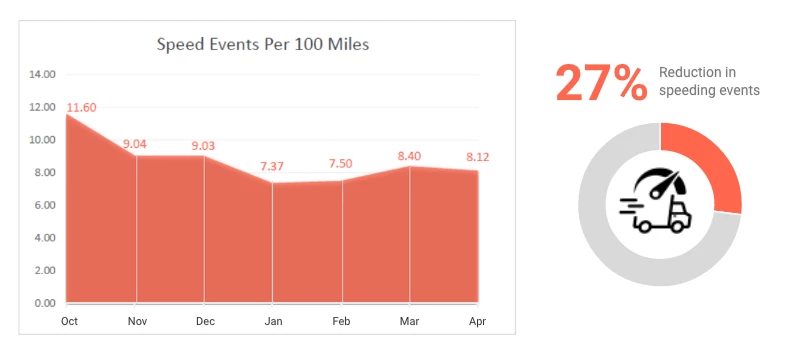
Over the study period, speeding events per 100 miles declined by 27%.
Speeding remains one of the leading contributors to serious road incidents and operational risk. By combining real-time driver feedback with targeted coaching, the integrated camera solution helped reduce risky behavior across a large, active fleet.
The impact extends beyond safety:
- Lower exposure to collision-related costs
- Reduced fuel consumption associated with high-speed driving
- Improved accountability and coaching effectiveness
What This Means for Your Fleet
Reducing speeding across a large fleet requires more than policy. It requires visibility and consistent reinforcement.
If you’re not seeing reductions achieved, it may indicate limited insight into driver behavior or lack of accountability.
This study shows that meaningful improvement is achievable even at scale.
Aggressive Driving is a Leading Indicator of Cost and Risk
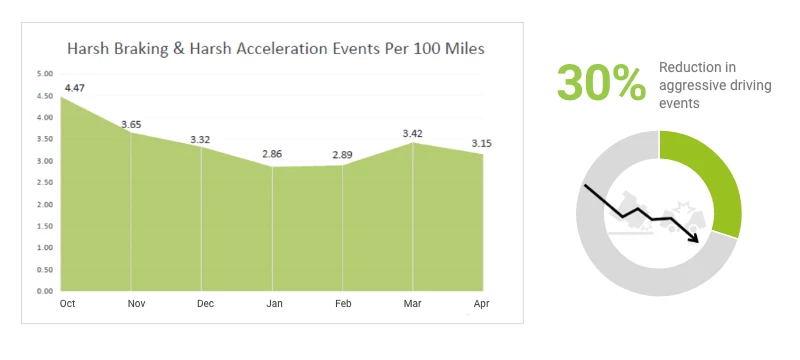
Aggressive driving behaviors, including harsh braking and harsh acceleration, were also tracked throughout the study.
Following implementation of integrated cameras, the fleet achieved a 30% reduction in harsh braking and acceleration events per 100 miles.
These improvements matter because aggressive driving contributes to:
- Increased vehicle wear and tear
- Higher maintenance costs
- Elevated fuel consumption
- Greater collision exposure
Reducing these behaviors improves both safety performance and total cost of ownership.
What This Means for Your Fleet
Aggressive driving increases fuel use, maintenance cost, and operational risk. Tracking and reducing these behaviors is critical to improving overall fleet performance.
Consistent reductions signal that drivers are adapting to increased visibility and feedback.
Visibility Changes Behavior
The study demonstrates that when drivers understand their actions are being recorded, reviewed, and supported with coaching, measurable behavior change follows.
Integrated cameras don’t just document incidents.
They influence daily driving decisions.
For fleets seeking to reduce risk, improve accountability, and control operational costs, visibility is not optional, it’s strategic.
Ready to Strengthen Safety and Reduce Cost Across Your Fleet?
See how integrated cameras within TN360 can help drive measurable performance improvements across your vehicles.
**Results are based on a limited pilot study conducted under specific operational conditions. Individual fleet results may vary depending on vehicle type, driver behavior, operating environment, implementation approach, and other factors. Past performance does not guarantee future results.